
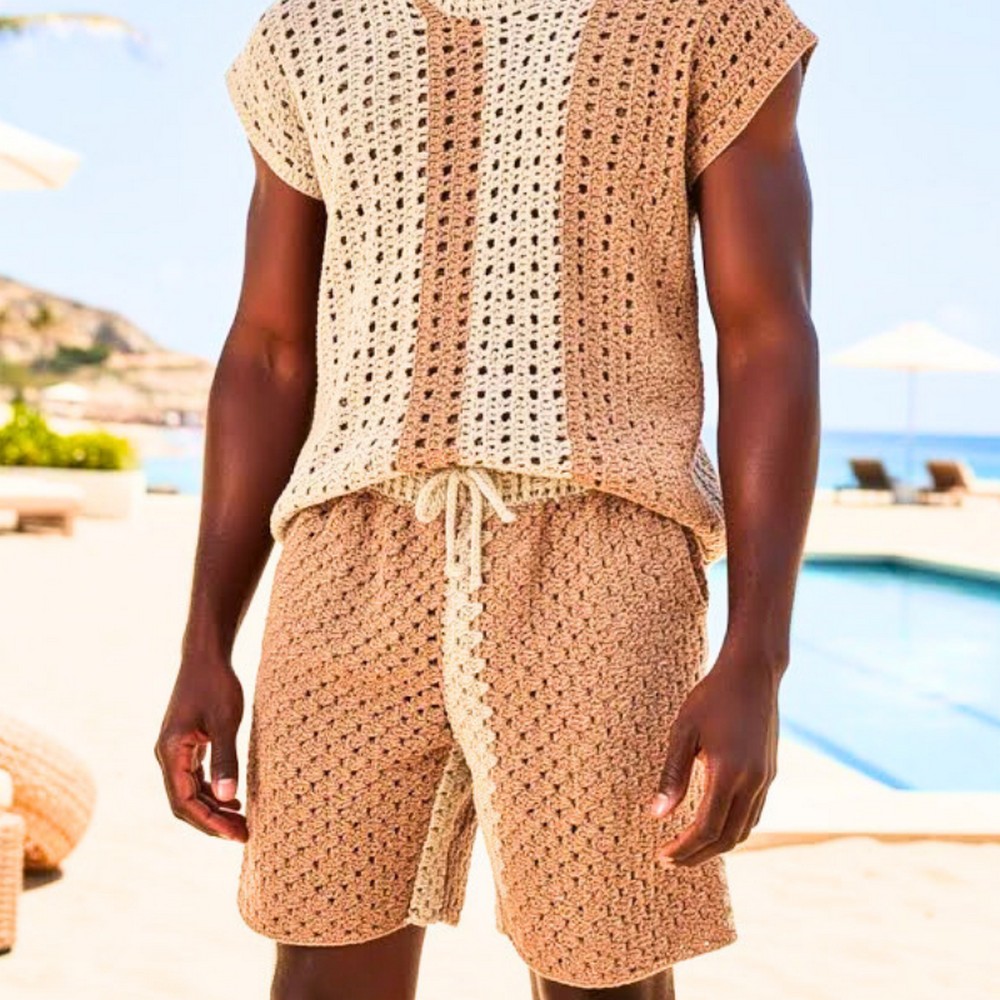
The crochet color block vest is a cozy, stylish, and eye-catching addition to anyone's wardrobe. Made with two bold or complementary colors, this vest stands out while keeping things simple. It’s wearable art, perfect for layering over a t-shirt or lightweight sweater to keep warm on breezy days or bring a pop of creativity to your outfit. You can customize the colors to match your personality, making it special for yourself or as a thoughtful handmade gift for your loved ones.

Two-Tone Crochet Vest Pattern
Crocheting this crochet vest is easier than you might think. Its design uses simple crochet stitches and alternating rows to create a beautiful texture with just a little effort. You’ll make two panels, one for the front and one for the back, then join them together for an effortless finish. With clear measurements for the chest area and plenty of room for customization, the vest fits perfectly every time. It’s not just a warm piece, it’s something you’ll feel proud to wear or share.
Credit LaDenser Crochets
Materials & Tools Needed
- Yarn: Milk Cotton Yarn (Medium Weight, any color combination you prefer)
- Crochet Hook: 3.5 mm
- Additional Tools:
- Measuring tape
- A pair of scissors
- Darning needle
- At least 2 stitch markers
Pattern Abbreviations & Terminology
- ch – chain
- dc – double crochet
- sc – single crochet
- sl st – slip stitch
- st(s) – stitch(es)
- ch-sp – chain space
- sk – skip
- YO – yarn over
- RS – right side
- WS – wrong side
- This pattern uses US terminology.
Step-by-Step Instructions
Introduction/Measuring
- Start by measuring two main dimensions:
- Length: Measure from the shoulder down to the desired hem length of the vest. Ensure you do NOT stretch the fabric while taking measurements.
- Chest Width: Take the chest measurement of the person and divide it by 2—each panel (front and back) will be half the chest measurement.
Example Measurements:
- Length = 27 inches.
- Chest Width = 42 inches (divided by 2 is 21 inches per panel).
Back Panel
Foundation Chain:
2. Begin with the darker shade of yarn (if using multiple colors). Create a foundation chain of 94.
- The chain should be a multiple of 3 + 1 (e.g., 93 + 1 = 94).
- Ensure the foundation chain matches the measured vest length.
Row 1: (Solid dc row)
3. Start by blocking the last chain made.
- Chain 3 (this counts as your first dc).
- Work 1 dc in each chain across.
- At the end of Row 1, you should have 94 dc.
Row 2: (Mesh row)
4. Chain 3, turn your work.
- Skip the first st, work dc in the second st.
- Chain 1, sk next st, and work dc into the following st.
- Repeat: (dc, chain 1, sk 1) across the row.
- At the end of Row 2, work the final dc into the turning chain.
Row 3: (Solid dc row)
5. Chain 3, turn your work.
- Across the row, work 1 dc in every stitch, including the chain spaces.
- At the end of the row, place your final dc in the turning chain.
Row Pattern Alternation:
- Even rows (Row 2, 4, 6, etc.): Mesh rows with chain spaces.
- Odd rows (Row 1, 3, 5, etc.): Solid dc rows.
- Continue alternating rows until the width of the back panel equals half of the chest measurement (in this case, 21 inches).
- In the example, this requires 41 rows.
- Finish on a solid row (odd-numbered row).
Middle Marking:
7. Identify the middle row (Row 21 in the example). Place a stitch marker at the center row.
- Measure 3.5 inches outward from the center on both sides, marking with stitch markers.

Front Panel
The front panel will follow the same method as the back panel but will include a neckline.
Foundation Chain:
9. Begin with the same foundation chain length (94) as the back panel.
Work Rows:
10. Alternate rows between solid (dc) and mesh rows (dc + chain spaces) until you reach the first marked stitch (shoulder height).
Neckline Shaping:
11. Begin creating the neckline in the following rows by reducing stitches:
- Row 1 of Reduction: Reduce 6 stitches at the neckline.
- Row 2 of Reduction: Reduce 5 stitches.
- Row 3 of Reduction: Reduce 5 stitches again.
- Row 4 of Reduction: Reduce 1 stitch.
- Row 5 of Reduction: Reduce 1 stitch.
- Repeat reductions until neckline shaping matches the tutorial's instructions.
Increase Marking/Mirroring:
12. Once neckline shaping is complete on one side, mirror the increase rows for the opposite side of the panel to match the tutorial exactly.

Joining Panels
Shoulders:
13. Align the front and back panels. Using a matching yarn color, join the shoulder seams with sc stitches—place 2 sc stitches into each row on both sides.
Sides:
14. Determine the armhole measurement (example: 9 inches). Mark this measurement on both panels.
- Join the panels below the armhole using sc stitches, working stitch-for-stitch.
Sleeve Extensions (Optional)
Add small sleeve extensions for extra coverage.
Row 1:
16. From the edge of the armhole, attach yarn and chain 3.
- Work a mesh row (dc, chain 1) around the armhole edge.
Row 2:
17. Work a solid row of dc, placing 1 dc into every stitch and chain space.
- Slip stitch, chain 1, and fasten off.

Borders
Bottom Border:
19. Start at the seam.
- Attach yarn with a slip knot.
- Work 2 sc into each row edge, alternating occasionally with 1 sc when necessary for evenness.
- At the end, sl st into the first sc, chain 1, and fasten off.
Neckline Border:
20. Begin at the corner of the neckline.
- Work 1 sc into every stitch around the neckline.
- For rows, alternate: 2 sc into one row edge, 1 sc into the next row edge.
Optional Ribbing:
21. Add ribbing with alternating front post dc (fpdc) and back post dc (bpdc) for texture.
- Work multiple rows of fpdc/bpdc as desired.
Finishing Techniques
- Use a darning needle to weave in all loose ends.
- Block your vest (optional) to achieve the desired shape and drape.